Deshaun Watson drew more Comeback Player of the Year support on October 26, when Tony Grossi argued that he deserved consideration while placing him behind Patrick Mahomes. For Cleveland, the useful question is whether the late-game precision can become the foundation of a dependable offense.
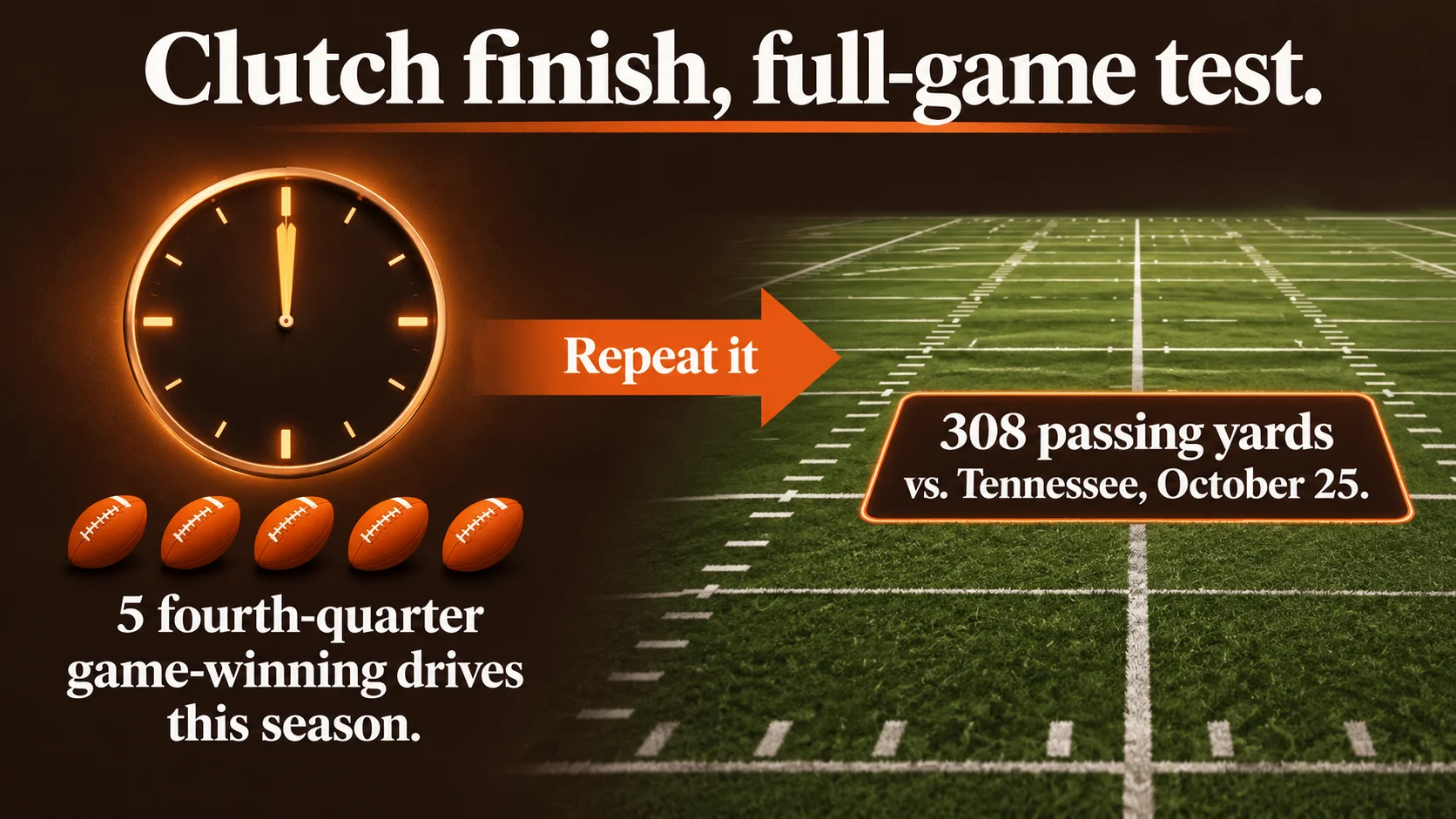
That discussion follows Watson's October 25 finish against Tennessee. Cleveland won 27-24 to improve to 5-2, and Watson completed 25 of 36 passes for 308 yards, his first 300-yard game with the Browns, plus a rushing touchdown, team writer Brian D'Aguanno reported. The passing production gives the award argument substance beyond the ending.
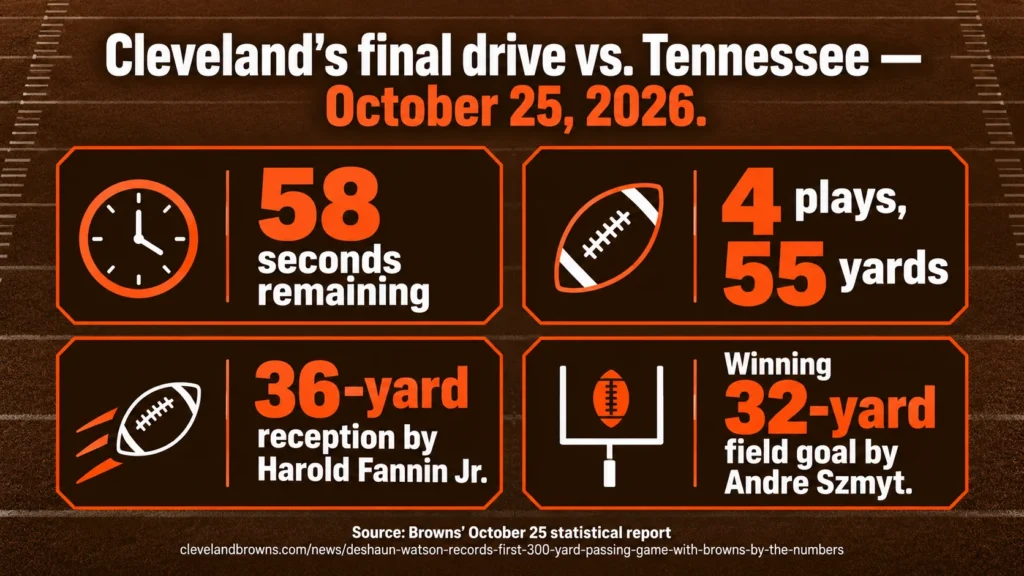
With 58 seconds remaining, Watson directed a four-play, 55-yard drive. A 36-yard completion to Harold Fannin Jr. helped set up Andre Szmyt's winning 32-yard field goal, the Browns' statistical report confirmed. Those are concrete contributions under pressure, and they deserve weight.
The Browns credited Watson with five fourth-quarter game-winning drives, making him the third quarterback since the 1970 merger with one in each of his team's first five wins. He completed all three final-drive passes for 50 yards against Tennessee, according to the team's October 26 report. That accuracy is a stronger measure than the winning label alone.
The comeback has a documented injury backdrop. Cleveland announced on January 10, 2025 that Watson had undergone a second operation on his right Achilles tendon the previous day after a re-rupture. Returning to productive football after that history gives this discussion its foundation.
Earlier, Heavy's J.R. DeGroote reported on October 25 that Cleveland.com's Mary Kay Cabot also considered Watson worthy of award discussion while calling Mahomes the frontrunner. The case for Watson should turn on what he delivers over the next stretch.
Grossi's October 26 report included guard Zion Johnson's assessment that Watson maintains composure and control in pressure situations. That teammate perspective helps explain the confidence behind the comeback argument: the final possession offers evidence of command when the margin for error shrinks.
NFL logs list zero passing touchdowns on October 18 and 25. Those results make it reasonable to ask for more scoring through the air, even while crediting the touchdown he supplied on the ground. A productive afternoon should be judged across the whole game.
The supporting work deserves attention. Fannin finished with six catches for 91 yards, Quinshon Judkins rushed for 96 yards and two touchdowns, and Cleveland allowed a season-low one sack, the team reported. That combination offers a sensible blueprint for the next stretch.
Watson emphasized execution in the Browns' October 26 report: "I get the ball out to get the guys catch-and-run opportunities." Cleveland generated a season-high 491 total net yards. Protection and contributions from teammates should remain central to evaluating his performance.
Cleveland's next game is at Pittsburgh on November 1, according to the team's October 25 recap. That matchup gives Watson an opportunity to connect the encouraging Tennessee performance to what comes next.
For fans following the Browns' season, three questions should guide the evaluation: Is Watson creating productive possessions before the closing minutes? Is he helping the offense stay on schedule? Can he keep spreading the work instead of needing a dramatic final answer?
An award-worthy case would grow from that combination: pressure execution backed by sustained production.
Images: AI-generated images.
Leave a Reply