Category: Browns

  • Maliek Collins extension gives Browns an interior anchor

    Maliek Collins extension gives Browns an interior anchor

    The Cleveland Browns announced defensive tackle Maliek Collins' two-year contract extension on October 26, 2026, in Kelsey Russo's team report. The move gives Cleveland continuity in the middle of its defensive front.

    NBC's Mike Florio reported October 24, citing agent Drew Rosenhaus, that the extension carries $30 million with $23 million guaranteed.

    The agreement runs through 2028, Scott Petrak reported October 26. That reported endpoint puts next season within a longer commitment and gives Cleveland time to assess the return.

    Through seven starts in 2026, Collins had 3.5 sacks, 17 tackles, six tackles for loss and eight quarterback hits, according to the Browns' October 26 announcement.

    Collins recorded a career-high 6.5 sacks in 12 games in 2025 before a quadriceps injury required surgery and ended his season, the Browns reported. The same announcement says he returned for the opening week of 2026. That history makes availability part of the evaluation: sustained production would make a stronger case for the investment than another impressive but interrupted stretch.

    Collins initially joined Cleveland in March 2025 and had already worked with defensive line coach Jacques Cesaire in Houston, the team noted. That familiarity makes retention easier to understand: Cleveland can keep developing an existing working relationship instead of introducing a replacement to the same job.
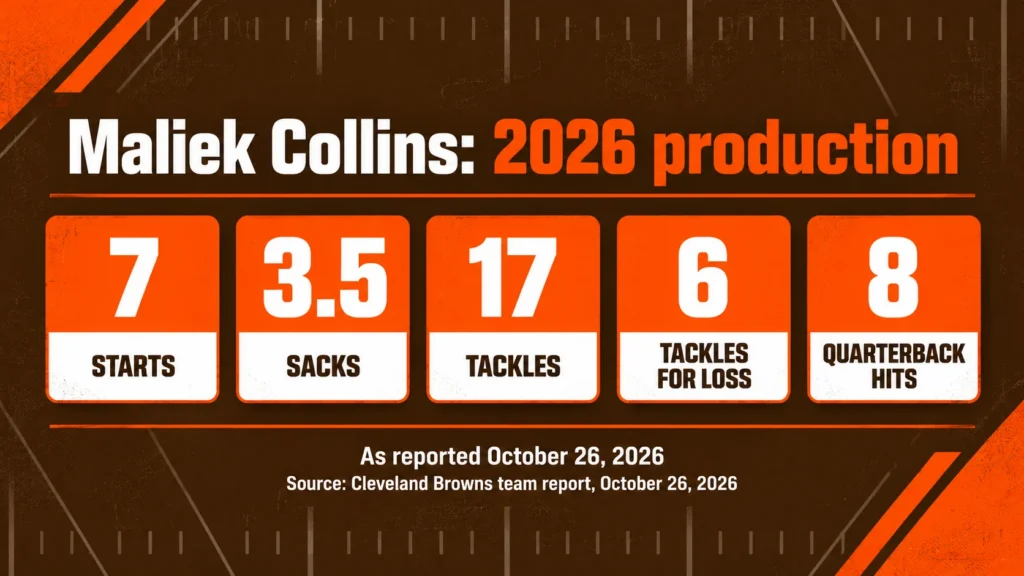
    Maliek Collins' 2026 totals as reported October 26: seven starts, 3.5 sacks, 17 tackles, six tackles for loss and eight quarterback hits.
    Production through seven starts, according to the Browns' October 26, 2026, announcement.

    Andrew Berry's explanation paired Collins' pass-rush variety and motor with his influence on younger linemen. "We're excited to keep Maliek in Cleveland for several more years," the general manager said in the team announcement.

    Coach Todd Monken said Collins earned the extension and praised his fit, work ethic and quiet leadership, Petrak reported. If younger linemen improve their preparation and execution alongside Collins, the benefit could extend beyond his own snaps. Leadership should complement the performance case; it should never become a substitute for judging what happens on Sundays.

    Monken praised Collins' explosiveness and ability to push the pocket in Russo's report. If Collins forces an earlier throw or prevents a comfortable step forward, Cleveland can benefit without adding to his sack column. Watch whether that pressure helps the defense finish possessions, including plays on which another defender gets the credit.

    For this season, the practical value is preserving an interior presence around whom Cleveland can prepare. The extension should not change the standard for evaluating his next game. Fans can welcome the decision while expecting the same attention to technique, effort and consistency that would matter without a new contract.

    For next season, Browns roster planning should use Collins' role to identify what the rest of the front needs. If younger linemen become more dependable, Cleveland could spread the work more effectively. If they do not, keeping one productive veteran would leave a larger burden on him.

    A useful test would compare the unit's performance when Collins is involved with how it functions through the rest of the rotation. If the defense depends on him to rescue too many possessions, his individual value could be clear while the group's development still falls short. That would argue for improving the supporting cast.

    The extension also calls for patience in judging its value. One quiet afternoon would not erase the case for retaining Collins, just as one dominant game would not settle it. The meaningful result would be a sustained stretch in which Cleveland gets dependable work from the player it chose to keep.
  • Deshaun Watson’s comeback case needs more than clutch wins

    Deshaun Watson’s comeback case needs more than clutch wins

    Deshaun Watson drew more Comeback Player of the Year support on October 26, when Tony Grossi argued that he deserved consideration while placing him behind Patrick Mahomes. For Cleveland, the useful question is whether the late-game precision can become the foundation of a dependable offense.

    That discussion follows Watson's October 25 finish against Tennessee. Cleveland won 27-24 to improve to 5-2, and Watson completed 25 of 36 passes for 308 yards, his first 300-yard game with the Browns, plus a rushing touchdown, team writer Brian D'Aguanno reported. The passing production gives the award argument substance beyond the ending.

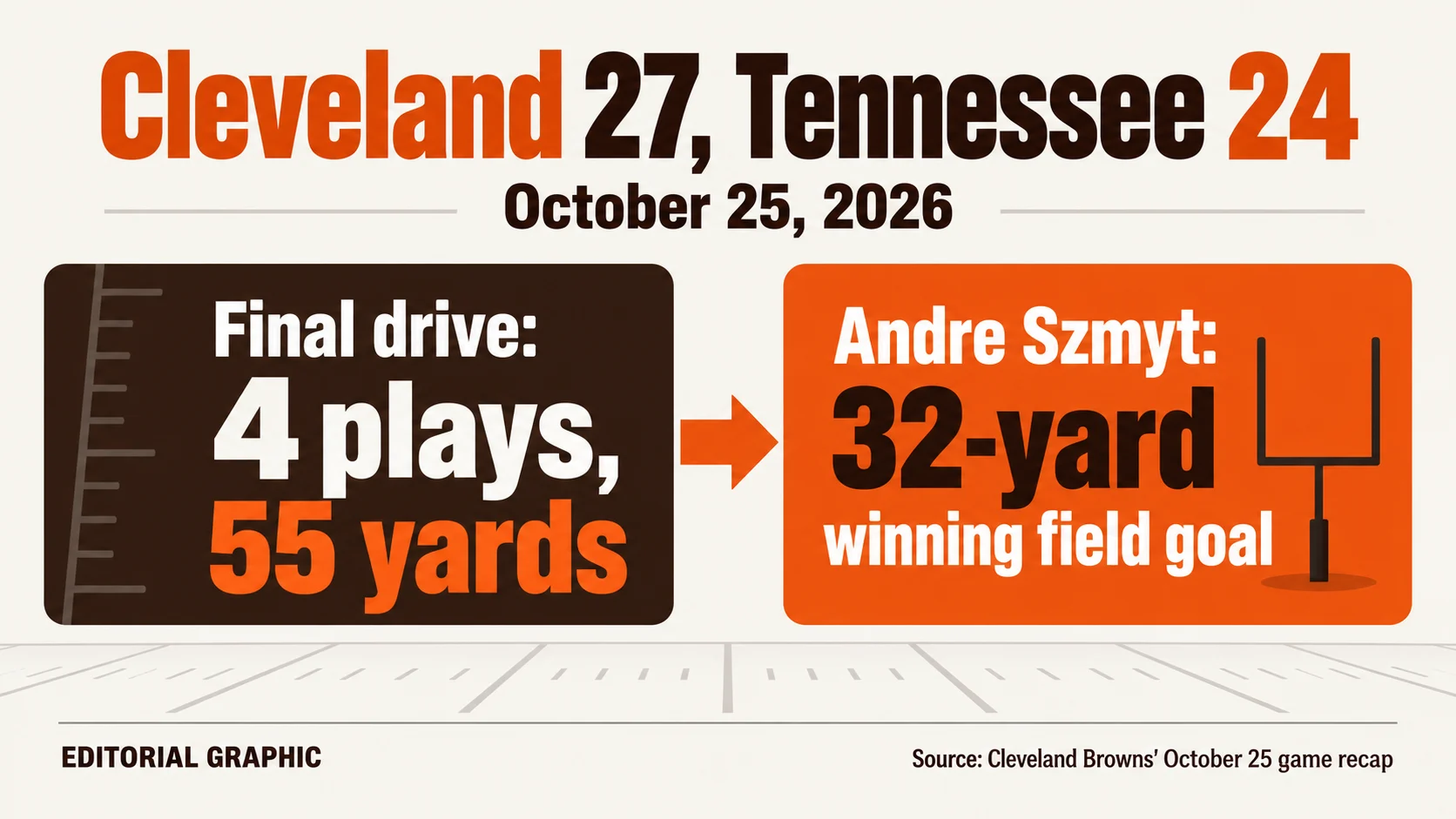
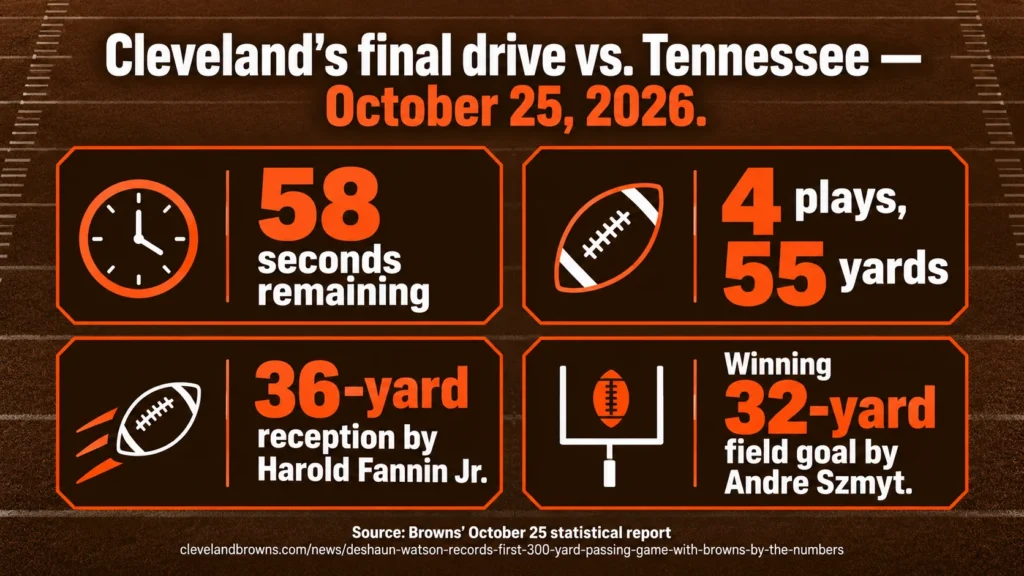
    With 58 seconds remaining, Watson directed a four-play, 55-yard drive. A 36-yard completion to Harold Fannin Jr. helped set up Andre Szmyt's winning 32-yard field goal, the Browns' statistical report confirmed. Those are concrete contributions under pressure, and they deserve weight.

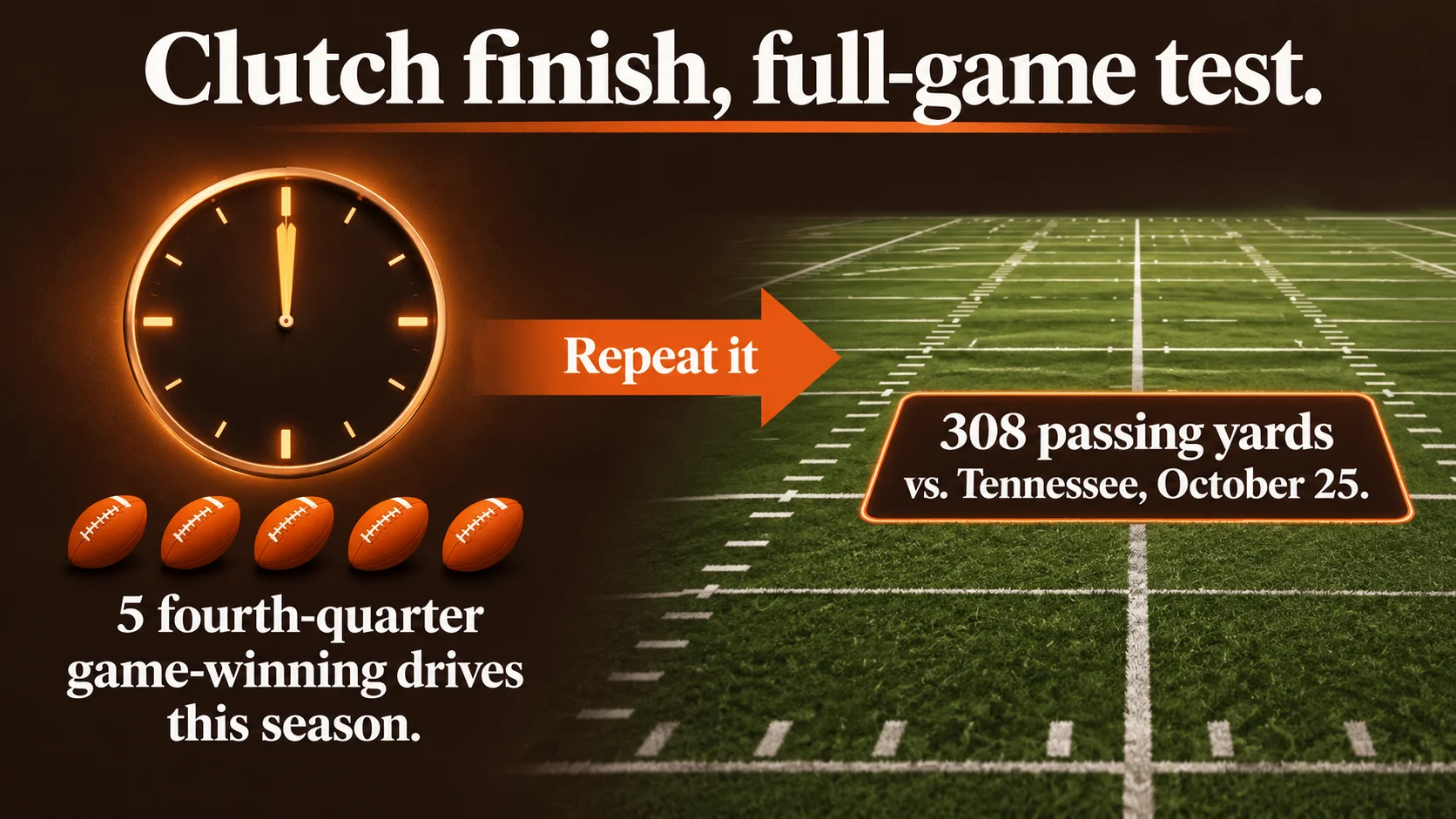
    The Browns credited Watson with five fourth-quarter game-winning drives, making him the third quarterback since the 1970 merger with one in each of his team's first five wins. He completed all three final-drive passes for 50 yards against Tennessee, according to the team's October 26 report. That accuracy is a stronger measure than the winning label alone.

    The comeback has a documented injury backdrop. Cleveland announced on January 10, 2025 that Watson had undergone a second operation on his right Achilles tendon the previous day after a re-rupture. Returning to productive football after that history gives this discussion its foundation.

    Earlier, Heavy's J.R. DeGroote reported on October 25 that Cleveland.com's Mary Kay Cabot also considered Watson worthy of award discussion while calling Mahomes the frontrunner. The case for Watson should turn on what he delivers over the next stretch.

    Cleveland's final drive: 58 seconds remaining, four plays covering 55 yards, a 36-yard reception and a winning 32-yard field goal.
    Cleveland's winning drive against Tennessee on October 25, 2026. Source: Cleveland Browns.

    Grossi's October 26 report included guard Zion Johnson's assessment that Watson maintains composure and control in pressure situations. That teammate perspective helps explain the confidence behind the comeback argument: the final possession offers evidence of command when the margin for error shrinks.

    NFL logs list zero passing touchdowns on October 18 and 25. Those results make it reasonable to ask for more scoring through the air, even while crediting the touchdown he supplied on the ground. A productive afternoon should be judged across the whole game.

    The supporting work deserves attention. Fannin finished with six catches for 91 yards, Quinshon Judkins rushed for 96 yards and two touchdowns, and Cleveland allowed a season-low one sack, the team reported. That combination offers a sensible blueprint for the next stretch.

    Watson emphasized execution in the Browns' October 26 report: "I get the ball out to get the guys catch-and-run opportunities." Cleveland generated a season-high 491 total net yards. Protection and contributions from teammates should remain central to evaluating his performance.

    Cleveland's next game is at Pittsburgh on November 1, according to the team's October 25 recap. That matchup gives Watson an opportunity to connect the encouraging Tennessee performance to what comes next.

    For fans following the Browns' season, three questions should guide the evaluation: Is Watson creating productive possessions before the closing minutes? Is he helping the offense stay on schedule? Can he keep spreading the work instead of needing a dramatic final answer?

    An award-worthy case would grow from that combination: pressure execution backed by sustained production.

  • Andre Szmyt’s latest winner shows Browns’ broader progress

    Andre Szmyt’s latest winner shows Browns’ broader progress

    The Cleveland Browns beat the Tennessee Titans 27-24 on October 25, 2026, improving to 5-2 on Andre Szmyt's 32-yard field goal, according to Brian D'Aguanno's official team recap. The finish rewarded an offense that created several ways to move the ball.

    It was Szmyt's third game-winning field goal this season and Cleveland's second straight walk-off victory, D'Aguanno reported in the team's October 26 player review. The kicker deserves the celebration. The more useful question for the Browns is how often they can give him a manageable final attempt.

    That starts with the backfield. In Kelsey Russo's team takeaways, Quinshon Judkins finished with a season-high 96 rushing yards on 17 carries and two touchdowns. Dylan Sampson added 45 yards on six carries, plus three catches for 32 yards. Both backs returned to the lineup for this game, Russo reported.

    The practical benefit is flexibility: Cleveland can distribute touches without asking one player to provide every answer. That is a stronger foundation for an offense than treating each late possession as a rescue mission.

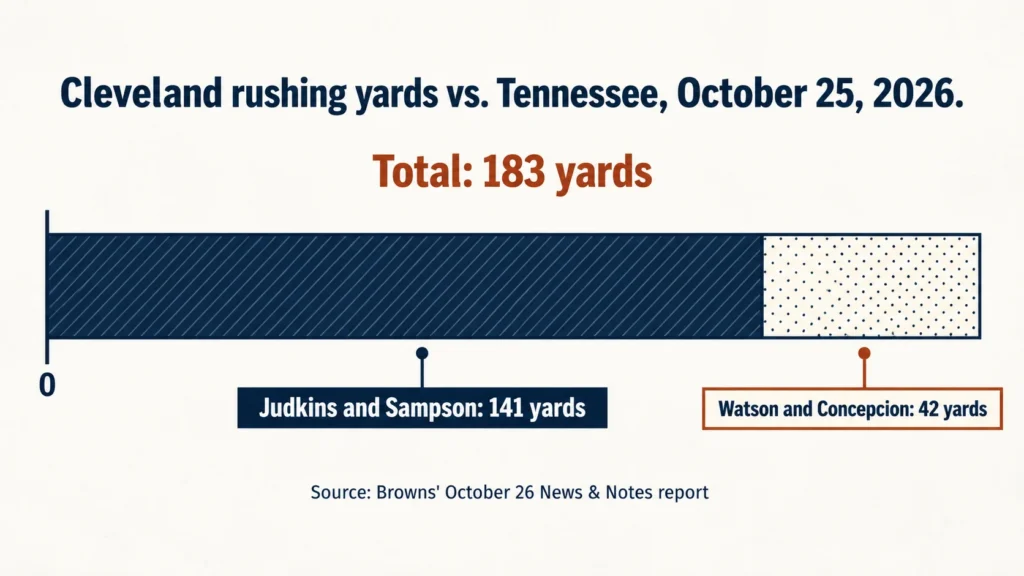
    The rushing production extended beyond the running backs. D'Aguanno's October 26 News & Notes credited Deshaun Watson and KC Concepcion Jr. with 42 combined rushing yards, complementing Judkins and Sampson's 141. Cleveland finished with a season-high 183 rushing yards and three touchdowns.

    The final possession required a different answer. Tennessee tied the score with 58 seconds remaining, Titans reporter Jim Wyatt wrote. Cleveland answered with a four-play, 55-yard drive, highlighted by Watson's 36-yard completion to Harold Fannin Jr., according to the Browns' recap. That explosive gain put Szmyt within 32 yards. Watson completed all three of his passes on the winning drive for 50 yards, D'Aguanno's player review reported.

    Of Cleveland's 183 rushing yards against Tennessee, Judkins and Sampson combined for 141; Watson and Concepcion added 42.
    Cleveland's rushing production extended beyond its running backs. Source: Cleveland Browns, October 26, 2026.

    This is the encouraging part of the finish: the offense created a reasonable opportunity, and the kicker converted it. Late execution involves more than the final swing. A passing play that changes field position can be every bit as consequential as the points that follow.

    The passing numbers reinforce that broader picture. The team recap reported Watson completed 25 of 36 passes for 308 yards, while Concepcion caught eight passes for 129 yards. Cleveland had substantial production through the air alongside its ground game, giving the comeback more substance than one successful kick.

    The warning was visible earlier. Wyatt reported that Tennessee took a 14-0 first-quarter lead and that Szmyt missed a 43-yard attempt before his winner. Cleveland recovered, but those setbacks help explain why the result should inspire confidence without making another narrow escape the preferred weekly plan.

    "Unbelievable team win. Not perfect at all. We're going to have to figure out how to start faster," head coach Todd Monken said in Russo's report. His assessment gives the celebration appropriate balance: finishing well and playing well throughout a game are different standards.

    The stakes now sharpen in the Browns' AFC North race. D'Aguanno's October 26 update placed Cleveland atop the division and identified Pittsburgh on November 1 as the next opponent, with a season sweep available. All five Browns wins have included fourth-quarter go-ahead drives, he reported.

    For Pittsburgh, the most useful carryover would be the variety Cleveland showed against Tennessee. Keep the backs involved, retain the explosive passing threat, and give the offense room to finish without first requiring another comeback. Szmyt has supplied the ending; the broader task is making the route there less demanding.

  • Browns vs. Steelers: Why Cleveland needs a cleaner rematch

    Browns vs. Steelers: Why Cleveland needs a cleaner rematch

    Todd Monken warned Cleveland on October 26 against repeating its excesses in Pittsburgh ahead of Browns vs. Steelers, according to the team's published transcript. He said the Browns crossed the line at times in the first meeting, including personal fouls.

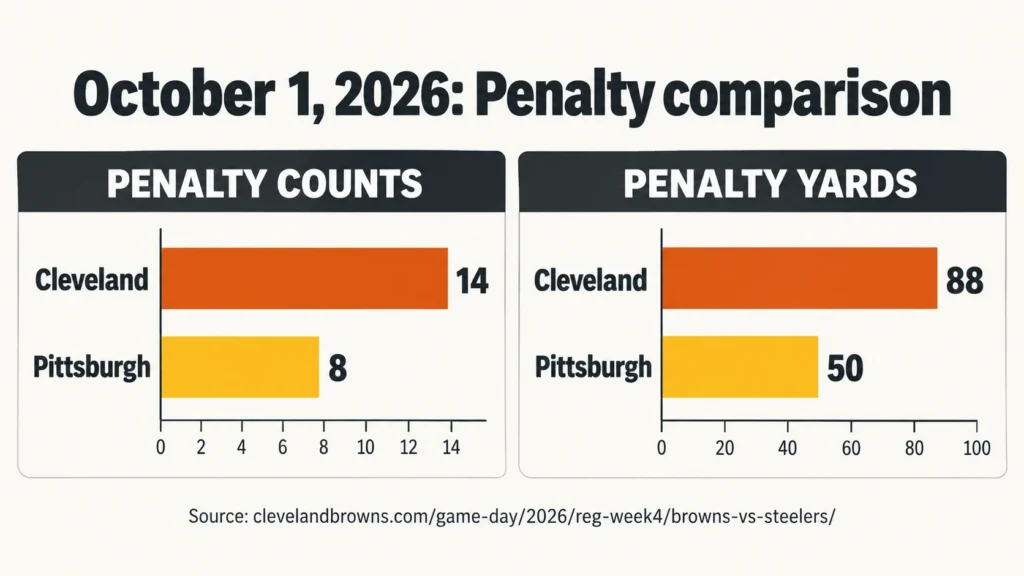
    For Cleveland, the strongest case for a cleaner performance starts with the first meeting's numbers. The official game center records 14 Browns penalties for 88 yards in their October 1 victory, compared with eight Pittsburgh penalties for 50 yards.

    Cleveland led 21-10 at halftime before winning 27-24 on Andre Szmyt's fourth-quarter 56-yard field goal, according to the game center's scoring summary. The result should encourage Cleveland without making the route to that win its preferred blueprint.

    Monken said Cleveland must match Pittsburgh's physicality while keeping its conduct under control. His description of the first meeting's excesses was blunt: "Browns hurting Browns." Both points appear in the October 26 transcript.

    Cleveland's priority should be keeping productive plays intact and avoiding situations that demand an immediate recovery. The penalty comparison gives Monken a concrete standard for this rematch: match the opponent's intensity without adding to the cost of each possession. A cleaner game could let Cleveland use more of its offense on favorable terms and force Pittsburgh to create its own opportunities. That would give the warning a measurable payoff beyond the final score.

    Discipline is one challenge; starting faster is another. "We've all been inconsistent, coaching and playing," Monken said in Brian D'Aguanno's October 26 team report, which noted that Cleveland had been outscored in the first quarter in six of seven games.

    October 1, 2026 penalties: Cleveland, 14 for 88 yards; Pittsburgh, 8 for 50 yards.
    Cleveland drew more penalties and lost more penalty yards in its 27-24 win. Source: official Browns Week 4 game center.

    The accountability extends to routine organization. In the same day's transcript, Monken addressed a 12-player punt-return mistake against Tennessee and assigned responsibility to players and coaches. The correction here could be more straightforward than solving the opening-quarter pattern: clear substitution responsibilities and a reliable count before the snap.

    A sharper opening should involve clear plans and communication as well as players carrying out assignments. But the slow-start statistic deserves its own attention: fewer penalties would not automatically solve it. Cleveland should judge the opening possessions by whether its preparation creates manageable situations, rather than treating every early problem as an emotional one.

    Cleveland has repeatedly recovered: all five wins have featured fourth-quarter go-ahead drives, the team reported October 26. That pattern suggests late-game resilience is a strength worth protecting. It also raises a different question for this week: could a steadier first quarter leave the Browns less dependent on a decisive final possession?

    The latest example came October 25, when Cleveland beat Tennessee 27-24 on Szmyt's 32-yard walk-off field goal, according to D'Aguanno's game recap. The next game is November 1 in Pittsburgh at 1 p.m. ET, as the team media center also lists.

    Cleveland enters that rematch at 5-2, atop the AFC North, with a chance to sweep the Steelers, according to D'Aguanno's October 26 report. A sweep would settle the season series in Cleveland's favor. For the Browns, that is a specific opportunity worth keeping at the center of the week, rather than letting the first meeting's emotions become the main story.

    Watch whether Cleveland avoids handing away yards, gets organized early and sustains its execution after taking a lead. Those tests should be evaluated separately: a win could coexist with another heavy penalty total, just as a sharper opening could still require a late drive. The strongest response to Monken would combine the result with progress in each area.

  • Browns Keep Four QBs as Dillon Gabriel Returns

    Browns Keep Four QBs as Dillon Gabriel Returns

    The Cleveland Browns activated quarterback Dillon Gabriel from injured reserve on October 26 and waived tight end Carsen Ryan to make room, the team announced Monday.

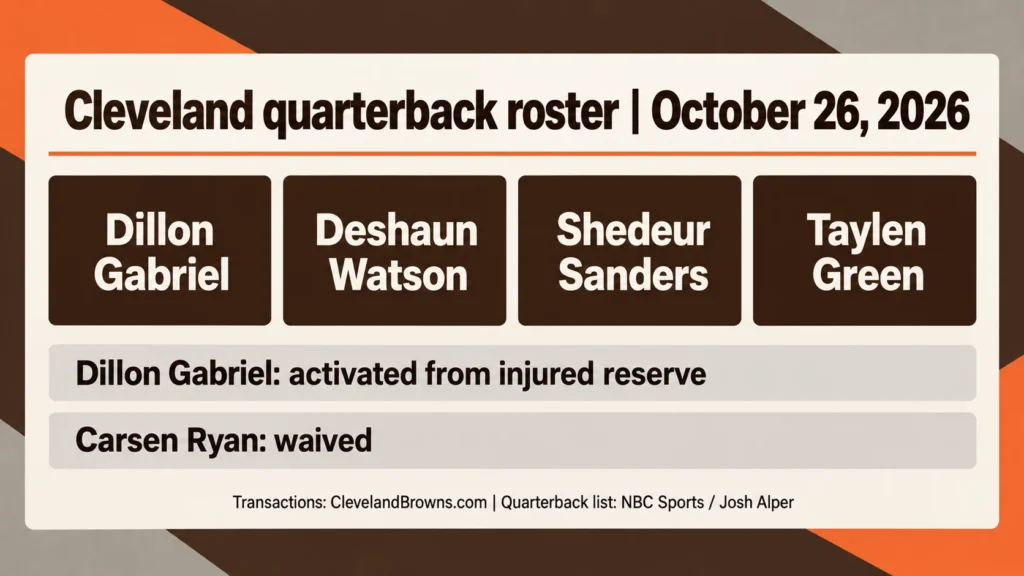
    NBC Sports' Josh Alper reported that Gabriel joins Deshaun Watson, Shedeur Sanders and Taylen Green, giving Cleveland four quarterbacks.

    Gabriel had been on injured reserve with a back injury since August 30 and returned to practice October 6, according to the Browns' announcement. Dawgs By Nature's Jared Mueller placed the activation 20 days after that practice return.

    Before the transaction, coach Todd Monken described the decision as involving both health and roster management with Andrew Berry. His October 26 press conference also connected roster decisions to practice needs, elevations and the players needed for each week's game.

    Asked whether carrying four quarterbacks on the active roster was feasible, Monken said, "Sure, it's possible." The team's transcript records that answer before the move. Read alongside the transaction, it shows a coach willing to accommodate a crowded room.

    The Pittsburgh assignment puts a practical edge on those choices. In Monday's remarks, Monken emphasized Wednesday preparation, matching Pittsburgh's physicality and avoiding undisciplined mistakes. That makes readiness across the roster a more useful focus than simply counting quarterbacks.

    Cleveland's four quarterbacks: Dillon Gabriel, Deshaun Watson, Shedeur Sanders and Taylen Green. October 26 transactions: Gabriel activated from injured reserve; Carsen Ryan waived.
    Cleveland retained four quarterbacks after activating Gabriel and waived tight end Carsen Ryan to make room on October 26, 2026.

    For Pittsburgh, the useful distinction is between having another quarterback available and needing him to contribute. An extra option could help if circumstances change during the week or the game. Its value would be less visible if Cleveland gets through the matchup without needing that depth.

    Ryan's role helps explain the other side of the decision. Mueller reported October 26 that the 2026 seventh-round pick had played six games, logging 73 special-teams snaps and two offensive snaps.

    That split matters when judging the cost. The offensive snap count suggests a limited role there, but the special-teams work deserves weight. Evaluating the waiver solely through Ryan's offensive contributions would miss where he had been doing most of his work. The practical test is whether Cleveland can cover those responsibilities cleanly. A reserve's value can come from helping several units function, so the evaluation should include the replacement workload as well as the quarterback benefit.

    My read: the central question in these Browns roster decisions is whether another quarterback's potential value outweighs the weekly contribution available from another position. Keeping another quarterback can make sense as insurance, particularly if that player can continue developing. That benefit has to justify the space.

    The team also listed Gabriel's experience: the 2025 third-round pick has appeared in 10 games, starting six, with 937 passing yards and seven touchdowns. Cleveland is retaining a young quarterback with regular-season work to build on, giving his development a concrete starting point.

    Those starts give Cleveland actual game work to evaluate. For the season, the useful development question is whether Gabriel becomes more dependable when his opportunity comes. Passing totals alone are a narrow measure of that progress; command of the offense and decision-making would offer a fuller picture. A larger role should follow demonstrated progress rather than the roster count itself.

    The next useful checkpoints are Gabriel's practice work and Cleveland's game-day selections. There is a balance to strike: enough practice attention for Gabriel to progress, while keeping preparation sharp for the players most likely to be needed against the Steelers.