
Todd Monken warned Cleveland on October 26 against repeating its excesses in Pittsburgh ahead of Browns vs. Steelers, according to the team's published transcript. He said the Browns crossed the line at times in the first meeting, including personal fouls.
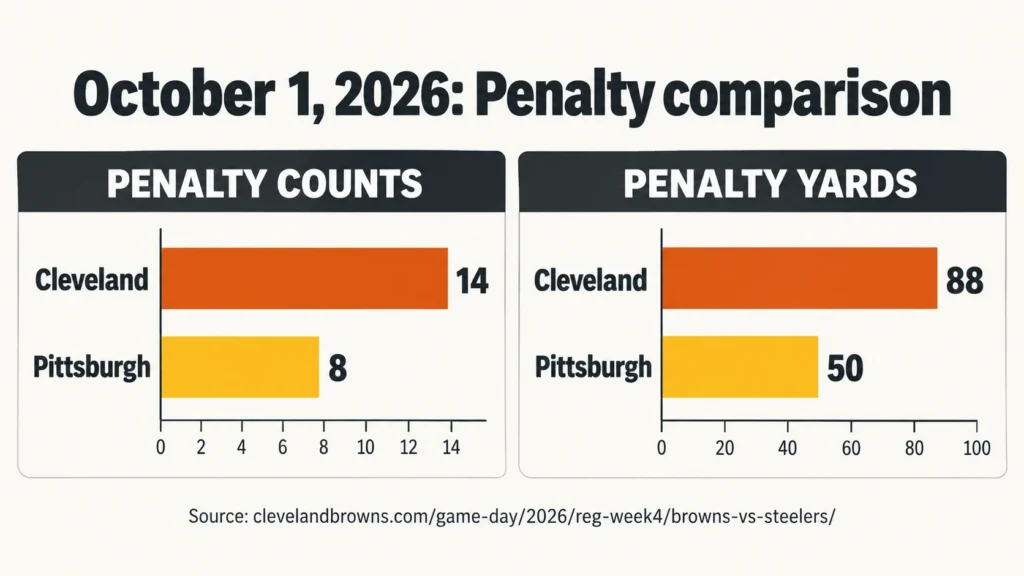
For Cleveland, the strongest case for a cleaner performance starts with the first meeting's numbers. The official game center records 14 Browns penalties for 88 yards in their October 1 victory, compared with eight Pittsburgh penalties for 50 yards.
Cleveland led 21-10 at halftime before winning 27-24 on Andre Szmyt's fourth-quarter 56-yard field goal, according to the game center's scoring summary. The result should encourage Cleveland without making the route to that win its preferred blueprint.
Monken said Cleveland must match Pittsburgh's physicality while keeping its conduct under control. His description of the first meeting's excesses was blunt: "Browns hurting Browns." Both points appear in the October 26 transcript.
Cleveland's priority should be keeping productive plays intact and avoiding situations that demand an immediate recovery. The penalty comparison gives Monken a concrete standard for this rematch: match the opponent's intensity without adding to the cost of each possession. A cleaner game could let Cleveland use more of its offense on favorable terms and force Pittsburgh to create its own opportunities. That would give the warning a measurable payoff beyond the final score.
Discipline is one challenge; starting faster is another. "We've all been inconsistent, coaching and playing," Monken said in Brian D'Aguanno's October 26 team report, which noted that Cleveland had been outscored in the first quarter in six of seven games.
The accountability extends to routine organization. In the same day's transcript, Monken addressed a 12-player punt-return mistake against Tennessee and assigned responsibility to players and coaches. The correction here could be more straightforward than solving the opening-quarter pattern: clear substitution responsibilities and a reliable count before the snap.
A sharper opening should involve clear plans and communication as well as players carrying out assignments. But the slow-start statistic deserves its own attention: fewer penalties would not automatically solve it. Cleveland should judge the opening possessions by whether its preparation creates manageable situations, rather than treating every early problem as an emotional one.
Cleveland has repeatedly recovered: all five wins have featured fourth-quarter go-ahead drives, the team reported October 26. That pattern suggests late-game resilience is a strength worth protecting. It also raises a different question for this week: could a steadier first quarter leave the Browns less dependent on a decisive final possession?
The latest example came October 25, when Cleveland beat Tennessee 27-24 on Szmyt's 32-yard walk-off field goal, according to D'Aguanno's game recap. The next game is November 1 in Pittsburgh at 1 p.m. ET, as the team media center also lists.
Cleveland enters that rematch at 5-2, atop the AFC North, with a chance to sweep the Steelers, according to D'Aguanno's October 26 report. A sweep would settle the season series in Cleveland's favor. For the Browns, that is a specific opportunity worth keeping at the center of the week, rather than letting the first meeting's emotions become the main story.
Watch whether Cleveland avoids handing away yards, gets organized early and sustains its execution after taking a lead. Those tests should be evaluated separately: a win could coexist with another heavy penalty total, just as a sharper opening could still require a late drive. The strongest response to Monken would combine the result with progress in each area.